OpenAI o1-preview: reasoning tokens you pay for and cannot read
o1-preview launched 12 September 2024. Thinking is billed as output, the chain of thought stays hidden, and the IMO score in the post is not the preview.
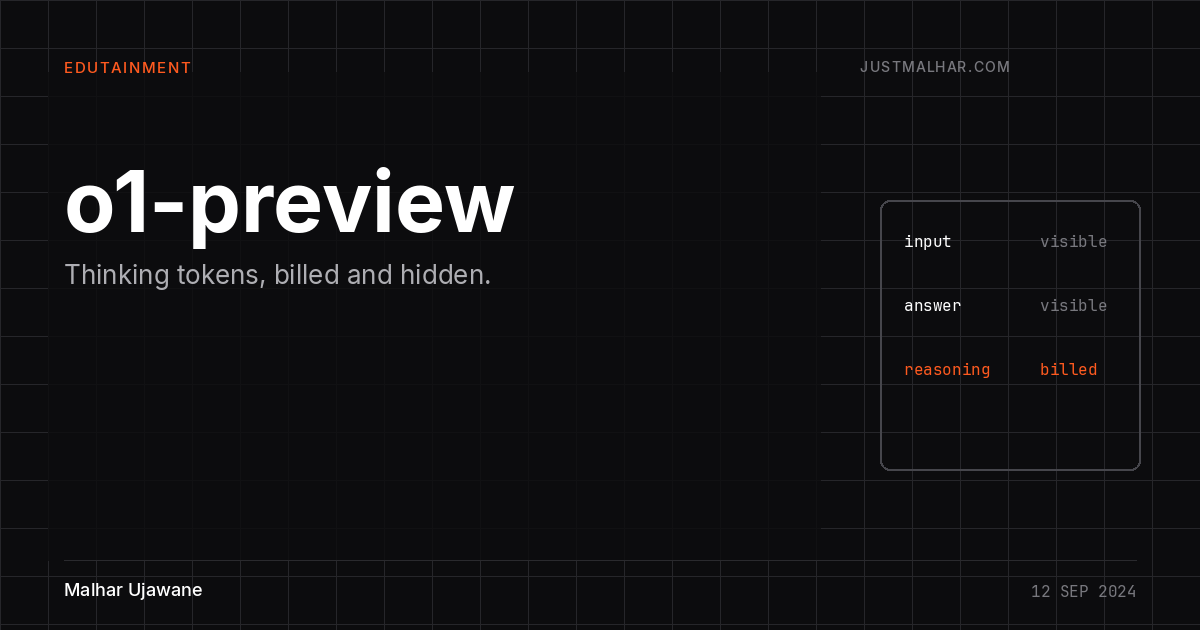
OpenAI shipped o1-preview on 12 September 2024. The post describes a series trained to spend more time thinking before it answers, released as a preview, with regular updates expected. Two models are in ChatGPT and the API that day: o1-preview and o1-mini.
I would price a call before I repeated a score from the post. Thinking is billed as output. The chain of thought stays hidden. The PhD comparison and the IMO score printed beside the launch belong to the next model update, which OpenAI evaluated alongside this release.
What did OpenAI ship on 12 September 2024?
ChatGPT Plus and Team get both models in the picker on launch day. Enterprise and Edu follow the next week. The weekly limits at launch are 30 messages for o1-preview and 50 messages for o1-mini. On 17 September 2024 the same post updates those caps: 50 per week for o1-preview, and 50 per day for o1-mini.
o1-mini is the smaller, faster, cheaper model, aimed at coding. The post says it is 80% cheaper than o1-preview. That sentence is the whole discount. It does not give o1-mini an input price or an output price, so this note does not split the 80% into two rates.
The API is a thinner product than the picker. Access starts at usage tier 5, and the rate limit in the post is 20 requests per minute. The same paragraph says the API then did not include function calling, streaming, system messages, and other features. A team that has been shipping tools on GPT-4o or Claude 3.5 Sonnet should read that list as the launch constraint.
Which scores belong to the next model update?
The launch post has a science line and an exam line that travel well in a screenshot, and both of them point at the next checkpoint.
The science line says the model performs similarly to PhD students on a physics, chemistry, and biology benchmark. The exam line is an IMO qualifying exam: GPT-4o solved 13%, and “the reasoning model” scored 83%. OpenAI’s post ties those results to the next model update, then in development, evaluated alongside the release. The preview you can select in the picker, and the snapshot you can call in the API, are a different set of weights.
I would quote the 13% and the 83% only with that referent in the same sentence, and I would leave the PhD comparison on the same update. The snapshot o1-preview-2024-09-12 has a price, a rate limit, a message cap, and an API that withholds the chain of thought.
What does one o1-preview call cost?
TechCrunch, the same day, reported the list price: $15 per million input tokens and $60 per million output tokens. The piece describes those rates as six times GPT-4o on both sides. I am keeping that description as theirs. The dollar figures are what the script uses. GPT-4o’s May rates, $5 and $15 per million, are in the GPT-4o note.
The model page still lists $15 input, $7.50 cached input, and $60 output. It lists a 128,000 token context, a 32,768 token max output, a knowledge cutoff of 1 October 2023, and the snapshot id o1-preview-2024-09-12. The status on that page is shut down. The preview has been retired. The script below bills the uncached $15 rate from the launch-day report. The $7.50 cached rate stays on the model page until a call actually hits cache.
Simon Willison’s notes the same day are the source I am using for how the bill behaves. Reasoning tokens are billed as output. They are absent from the API response. A request can take seconds to minutes. That is the operational detail I am taking from those notes.
This script prices one made-up basket. Eight thousand tokens in, four thousand tokens out. The four thousand stand in for the visible answer plus the reasoning tokens. The basket is made up, so the script can run with no network and no key.
# o1_preview_price.py — Python 3, no dependencies.
# o1-preview list price reported 12 September 2024: $15 input, $60 output, per million.
pin, pout = 15, 60
inp, out = 8_000, 4_000  # made-up basket; output includes reasoning tokens
usd = inp * pin / 1e6 + out * pout / 1e6
print(f"o1-preview  8k in, 4k out   ${usd:.2f} per call   ${usd * 1000:,.0f} per 1,000")
print(f"output share of that bill   {out * pout / 1e6 / usd:.0%}")
Output (Python 3):
o1-preview  8k in, 4k out   $0.36 per call   $360 per 1,000
output share of that bill   67%
One call on that basket is $0.36. A thousand of them are $360. The output share prints as 67% because the format rounds to the nearest percent. The diagram treats the same split as two-thirds, the exact share of this basket. Output is the expensive side, and it contains tokens the API does not return. Eight thousand input tokens sit inside the 128,000 context, and four thousand output tokens sit inside the 32,768 max output.

The gray block is the part I cannot review. The visible answer can go in a review queue. The reasoning tokens cannot: the response leaves them out, and the invoice still counts them at $60 per million.
The knowledge cutoff on the model page is 1 October 2023. A question about the world after that date is outside the weights, whatever the output budget does. The cutoff is a property of this snapshot. It is independent of the 83% line, which belongs to the next update.
What is missing from the API on day one?
Set the preview next to the two APIs a delivery lead could already buy.
GPT-4o, from 13 May 2024, is in the API with text and vision, a 128k context, and a price of $5 and $15 per million. The o1-preview API launches without function calling, without streaming, and without system messages. Function calling, from 13 June 2023, is the wire shape those tools use: the model returns a name and a JSON argument string, and your process runs the function. On this preview, that shape is one of the features the post says the API did not include. A workflow that depends on it stays on the earlier model until the preview grows the feature.
Claude 3.5 Sonnet, from 21 June 2024, is $3 and $15 per million with a 200k context. Anthropic’s internal agentic coding evaluation that day had Sonnet solving 64% and Claude 3 Opus solving 38%, in a harness where the model writes, edits, and executes code. That 64% is their harness. It is a June coding score, and it is here so the surface area is clear: Sonnet’s launch assumed tools. o1-preview’s API launch listed tools among the absences.
Speed belongs in the same column. Sonnet’s June claim was twice the speed of Claude 3 Opus. Willison’s notes on o1-preview record requests that take seconds to minutes. A ChatGPT cap of 30 messages a week, later 50 a week, and an API cap of 20 requests per minute at tier 5, describe a model you point at a few hard calls. o1-mini remains the coding-shaped option in the same launch, at the post’s 80% discount, with that discount still unsplit into an input price and an output price.
A system message is the other loss. The launch post includes system messages in the list of features the API did not have, so a standing instruction for format or a privacy line has to live in the user turn.
What I would do
I would bill the preview at $15 and $60 per million, and I would tell anyone reading the invoice that output includes reasoning tokens they will not see in the response. For a planning number I would use this basket: $0.36 a call, $360 a thousand, with about two-thirds of the call on the output side. The script prints that share as 67% after rounding. I would replace the four thousand with a real output total as soon as I had one. I would leave the cached $7.50 rate out of the estimate until I knew the call would hit cache.
I would keep the 83% IMO result and the PhD comparison on the next model update, in development at the time of the post. I would describe the preview with the snapshot id, the tier-5 limit of 20 requests per minute, the ChatGPT caps, and the list of API features the post says were missing. I would use o1-mini when the work is coding and the 80% discount is the point. I would stay on GPT-4o or Claude 3.5 Sonnet when the work needs function calling, streaming, or a system message.
I would keep a prompt I need to audit, token for token, off a model that bills a hidden chain. That criterion comes from the shape of the response Willison recorded the same day. A customer record, a contract, or an internal page would leave an audit hole where the chain should be. The model page marks the snapshot shut down. Hidden reasoning, priced as output, is the pattern this launch put on a bill.
Update, 29 October 2026
The preview is retired, and the snapshot on the model page is the one from launch day. The later write-up of the pattern is what reasoning models are: a hidden chain, billed as output. DeepSeek R1 is where an open model meets a reasoning-sized bill, and that post keeps the September 2024 list price in a different column from the paper’s o1-1217 scores. Claude Opus 4.5’s effort parameter is a later control on how freely a model spends tokens before it finishes. The 83% IMO figure and the PhD comparison stay on the next update from September 2024.