GPT-4o pricing: half of GPT-4 Turbo, and in the free tier
GPT-4o launched 13 May 2024 at $5 and $15 per million tokens, half of GPT-4 Turbo, with text and vision in the API.
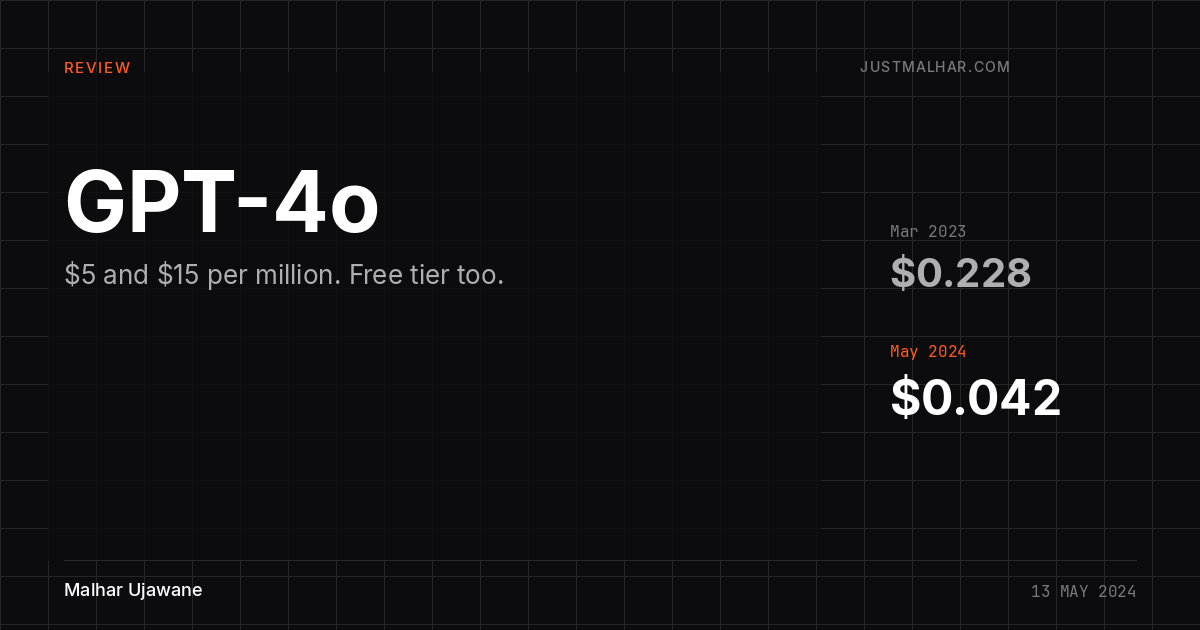
GPT-4o came out on 13 May 2024. OpenAI says the “o” stands for omni: text, audio, image, and video in, and text, audio, and image out. The same day’s API announcement prices text at $5 per million input tokens and $15 per million output tokens. OpenAI calls that half of GPT-4 Turbo, and 50% cheaper on both input and output. In ChatGPT, text and image are rolling out the same day, and the model is on the free tier.
The product change I keep is that the cheap model and the flagship became the same model, including for people who do not pay.
What did the 13 May launch include?
On audio, OpenAI reports a response in as little as 232 milliseconds, and an average of 320 milliseconds, which they compare to human conversational response time. On quality, GPT-4o matches GPT-4 Turbo on English text and code, does better on non-English text, runs faster, and costs 50% less in the API. They also say it is better at vision and audio than existing models. English and non-English are separate sentences in that list. A product that ships in several languages is buying the second one, and the bill for that second one depends on the tokenizer, which I take up below.
ChatGPT and the API received different surfaces.
In ChatGPT, text and image rolled out the same day, on the free tier. Plus users get up to 5x higher message limits. A new Voice Mode that uses GPT-4o is in alpha for Plus “in the coming weeks.” The 232 and 320 millisecond figures are the launch claim for how fast the model answers audio. Voice Mode for Plus, and audio in the API, are still ahead of this week.
In the API, the live surface is text and vision, in Chat Completions, Assistants, and Batch. Token generation is 2x faster than GPT-4 Turbo. Rate limits are 5x higher, up to 10 million tokens per minute, ramping over the following weeks for high-usage developers. Context is 128k. The knowledge cutoff is October 2023. Audio and video in the API are planned for a small group of partners in the coming weeks.
The Plus “5x” is a message cap in the app. The API “5x” is a tokens-per-minute ramp whose published top is 10 million, for high-usage developers, over the following weeks. I would read the limit on the key I would call, and I would treat 10 million as the top they named. The generation-speed claim, 2x against Turbo, is the figure for a text migration. The 232 millisecond floor and the 320 millisecond average are the audio response times in the launch post. Voice Mode for Plus, and the partner preview for API audio, are availability. Both are still ahead of this week.
Which dollars does the script use?
OpenAI’s half-price sentence compares GPT-4o with GPT-4 Turbo. The 13 May posts state the ratio and the new rates, $5 and $15 per million. The script below uses another baseline, the one I can recompute from a post already on this site. The GPT-4 8,192-token model from 14 March 2023 was $30 per million input tokens and $60 per million output tokens. The same note has the limited 32,768-token model at $60 and $120 per million. Half of Turbo stays OpenAI’s sentence. The chart draws the 8,192-token card.
The call is hypothetical. The prices are the launch posts. Six thousand tokens in and 800 tokens out is a made-up basket that fits in the March 8,192 window and in the new 128k window. No install, no network, no API key.
# gpt4o_price.py — Python 3, no dependencies.
# GPT-4 8k: OpenAI, 14 March 2023, $30 / $60 per million.
# GPT-4o: OpenAI API announcement, 13 May 2024, $5 / $15 per million.
PRICE = {"GPT-4 8k (Mar 2023)": (30, 60), "GPT-4o (May 2024)": (5, 15)}
inp, out = 6_000, 800
for name, (pin, pout) in PRICE.items():
    usd = inp * pin / 1e6 + out * pout / 1e6
    print(f"{name:<22} ${usd:.3f} per call   ${usd * 1000:,.0f} per 1,000")
Output (Python 3):
GPT-4 8k (Mar 2023)    $0.228 per call   $228 per 1,000
GPT-4o (May 2024)      $0.042 per call   $42 per 1,000
Same basket, two list prices. On the March 2023 8k rate the call is $0.228, and a thousand calls are $228. On the May 2024 GPT-4o rate the call is $0.042, and a thousand calls are $42. Input in the table moved from $30 per million to $5. Output moved from $60 per million to $15. The March 8k card is what those two lines compare. The 50% sentence remains the Turbo comparison.

The basket is one turn, a long prompt and a short answer. An agent that resends history, or a prompt that fills 128k, is a different bill at the same $5 and $15 rates, paid again on the input each time the history is resent. Replace inp and out with a trace before $0.042 is quoted as the cost of a feature. Chat Completions, Assistants, and Batch are the three surfaces named today, and the pair I would start from on all three is $5 and $15 per million.
What does a free flagship change?
On 13 May the name in the free ChatGPT tier and the name on the API price list are both GPT-4o. Plus raises the message ceiling, up to 5x. The model under the free tier is the flagship, including for people who do not pay, and internal text is what they will be tempted to paste.
From a privacy and data-platform seat, the acceptance criterion is to separate “the flagship is free to open” from “this text is allowed to leave the building.” The API is the channel I can put under a contract, at a rate the script recomputes. The free app is the channel a colleague can open today, for text and image. Voice Mode is still ahead, for Plus, and voice is a different kind of data from typed text, so the question of what may be sent gets asked again when the alpha arrives. I would write down the path, the text that is in scope, and who may turn voice on, and I would take that list to the people who own the policy. The price cut answers the invoice.
How should I read the 128k window?
GPT-4o’s API context is 128k tokens. In March 2023 the public GPT-4 window was 8,192 tokens, and limited access to the 32,768-token model sat beside it at $60 and $120 per million, with long-context quality still being improved. The script’s 6,000-token prompt fits the old 8,192 window. A 128k window at $5 and $15 puts a long prompt on the flagship rate. The 32,768-token model was a separate, higher rate.
In February I wrote up Gemini 1.5 Pro from Google’s post: a standard context of 128,000 tokens, a private preview at 1 million with no cost during testing, and pricing tiers “coming soon.” OpenAI’s 128k is on the public price list this week. Google’s million-token tier was a private preview, and I still have no dollar rate for it. Their needle test finds a planted sentence. It does not grade whether the model reconciled two contradictory sections of a long prompt. Length is also separate from freshness: the knowledge cutoff is October 2023, so a task that needs the world after that month needs a source in the prompt, billed at $5 per million.
Why does non-English text change the bill?
OpenAI says GPT-4o is better on non-English text, and that the new tokenizer is more efficient there. For a bill, more efficient means the same sentence can become fewer tokens. The rate cut and a shorter count are two savings. The script shows the rate, with 6,000 and 800 held still. Pricing a Gujarati prompt from an English token count times $5 prices the wrong string.
I am leaving the Gujarati count out. A measured count belongs in a write-up that names the tokenizer. Re-tokenize prompts in the languages people actually send before treating $5, or the 50% against Turbo, as the whole saving. Vision is in the API today, and they say the model is better at it than existing models. The basket above is text. A vision feature needs a real call’s token usage on a real image, then the same $5 and $15 rates.
What I would do
I would move priced text traffic onto GPT-4o where the bar I care about is OpenAI’s line for English text and code: matching GPT-4 Turbo, at $5 and $15 per million. I would check non-English quality, and the token counts, on the prompts I would actually send. I would keep voice off the public API plan this week. The Plus alpha and the partner preview for API audio and video are both “in the coming weeks,” and a text migration does not need to wait on them.
I would brief the free tier in the same week. Customer text and internal documents stay on the API path I can put under a contract. The free app is for text that is already allowed there, and audio gets its own decision when Plus gets Voice Mode. I would re-run the script on a real trace before $0.042 appears in a doc. That figure is 6,000 in and 800 out. On the slide, half of GPT-4 Turbo stays OpenAI’s sentence, and $0.228 against $0.042 stays the March 8k comparison for this basket.
Update, 29 October 2026
The product fact that held is the flagship and the cheap model on one name, at $5 and $15 per million, including the free tier for text and image. The tokenizer measurement, with the tokenizer named, is in what are tokens. This post still has no Gujarati count.
Two later bills need a different script. o1-preview charges reasoning tokens you pay for and do not get back in the response, so a short answer can hide a long output line. Claude Opus 4.5’s effort parameter changes how freely the model spends tokens on a task. The May 2024 script still prices this basket on the March 2023 8k rate and on GPT-4o’s May rate. I use the later notes when the bill is no longer a flat input price times a flat output price.